2nd International Conference on Future Building & Sustainability
Seven research tracks, from AI and smart cities to education, policy and peace studies. Present peer-reviewed work online and publish it in an ISBN volume, with a DOI for every paper.
Abstracts close 4 December 2026 · open now
- Conference
- 28–29 January 2027Thursday & Friday, 09:00–17:00 ET (UTC−5)
- Abstracts due
- 4 December 2026Decision in about ten days
- Review
- Double-blindTwo or more reviewers per paper, via Microsoft CMT
- Proceedings
- ISBN chapter bookA DOI for every paper, open access (CC BY 4.0)
Programme · 7 tracks
Seven tracks, one future to build.
Papers are grouped by track for review and for the live sessions. Pick the one closest to your work; the committee can move it if another fits better.
- L01
AI for the Built Environment & Infrastructure
Machine learning for structural health monitoring · Generative and parametric design · Digital twins of buildings and networks
- L02
Smart Cities, IoT & Urban Digital Systems
Sensor networks and urban data platforms · Mobility and traffic systems · Smart grids and building energy management
- L03
Sustainable Engineering & Green Construction
Low-carbon materials and life-cycle assessment · Energy-efficient and net-zero buildings · Water, waste and circular construction
- L04
Peace & Conflict Resolution
Post-conflict reconstruction and infrastructure · Community mediation and social cohesion · Conflicts over land, water and energy
- L05
Education Technology & Intelligent Learning Systems
AI tutoring and learning analytics · Engineering and sustainability education · Online and blended learning at scale
- L06
Social Sciences, Human Behaviour & Sustainable Development
Behaviour change and household energy use · Housing, health and wellbeing · Inclusion and equity in urban development
- L07
Technology Policy, Governance & Legal Frameworks
Building codes and standards · Regulation of AI and data · Climate policy and green finance
Key dates
From abstract to proceedings in five months.
The January date leaves room for review before the conference. Plan around the December holidays: the abstract deadline falls before them.
- 01 Call for papers openSubmissions open on Microsoft CMT. Upcoming
- 02 Abstract deadline250–300 word structured abstract, any of the seven tracks. Upcoming
- 03 Abstract decisionReviewed on a rolling basis, about ten days after you submit. Rolling
- 04 Full paper deadline3,000–5,000 words, APA 7th edition. Upcoming
- 05 Final acceptanceDouble-blind review decision with reviewer comments. Upcoming
- 06 Registration & camera-readyAt least one author registers; final PDF uploaded to CMT. Upcoming
- 07 Conference, onlineTwo days of keynotes and parallel track sessions, 09:00–17:00 ET. Scheduled
- 08 Proceedings publishedChapter book with ISBN; a DOI for each paper. Upcoming
Deadlines close at 23:59 Eastern Time (UTC−5) on the date shown.
Process
How a paper gets to the programme.
Submit an abstract
250–300 words on Microsoft CMT. It takes a few minutes.
Abstract decision
About ten days later, with a note from the committee.
Full paper
3,000–5,000 words by 8 January, reviewed double-blind.
Register & present
One author registers by 20 January and presents online.
Published
Your paper appears in the ISBN chapter book with its own DOI.
Revision history
The first edition is in print.
RC-FBSIC 2026 ran online on 21–22 May 2026: 200 attendees, 21 papers, 6 countries. Its peer-reviewed chapters are collected in an open-access book anyone can download.
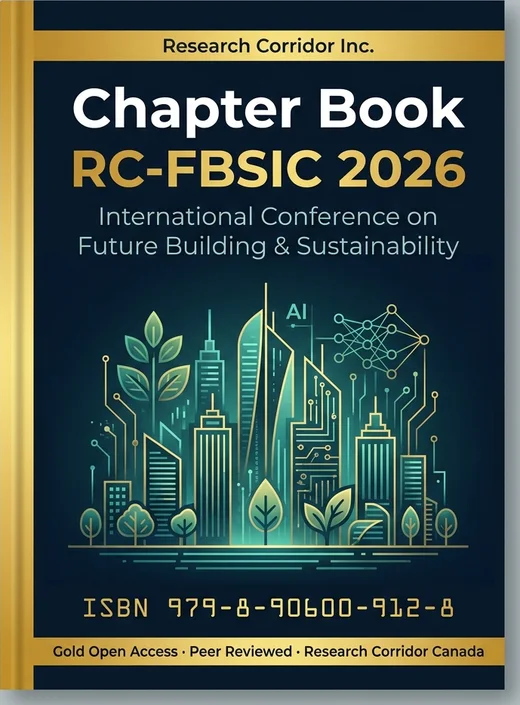
- Title
- Chapter Book RC-FBSIC 2026
- ISBN
- 979-8-90600-912-8
- Publisher
- Research Corridor Inc.
- Access
- Gold open accessCC BY 4.0, free PDF
| Rev. | Edition | Dates | Record |
|---|---|---|---|
| 01 | 1st edition | 21–22 May 2026 | Archived site · Chapter book |
| 02 | 2nd edition | 28–29 Jan 2027 | Call for papers |
Questions
Before you submit.
How do I submit a paper?
Create a free account on Microsoft CMT, choose a track, and upload a 250–300 word abstract. If the abstract is accepted you will be asked for the full paper. Step-by-step guide.
Is the conference peer-reviewed?
Yes. Every paper goes through double-blind review by at least two independent reviewers, managed in Microsoft CMT. Reviewers judge originality, method, relevance to the tracks, and clarity.
Where will accepted papers be published?
Accepted and presented papers appear in the RC-FBSIC 2027 chapter book, which carries an ISBN, and each paper receives a DOI. The 2026 volume is free to download as an example.
Is it online or in person?
Fully online, over Zoom or Microsoft Teams, on 28–29 January 2027, 09:00–17:00 ET (UTC−5). You can present from anywhere.
I presented in 2026. Can I submit again?
Yes, with new work. Extended versions of 2026 papers are welcome if they add substantial new results; say so in your cover note.
Who organises RC-FBSIC?
Research Corridor Inc. (Canada) together with Research Corridor Pvt Ltd (Pakistan), which publish the Research Corridor journals. The first edition ran in May 2026.
What language is used?
English, for abstracts, papers, presentations and the proceedings.